Installation & Safety Guides

For your personal safety, insurance compliance and legal compliance.

How to protect your geyser in freezing conditions
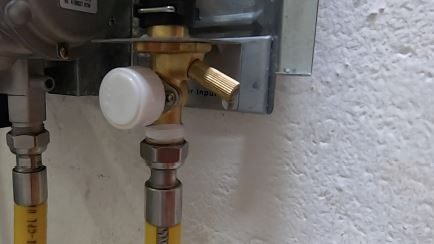
Over pressurisation valve on a gas geyser, with the brass grub screw to the right of the white valve cap

Freezing water expands, and the resulting water pressure can damage not only your gas geyser but also the other pipes and appliances around your house.

Fortunately, gas geysers come with an Over Pressurisation Valve (OPV), which is designed to let the expanding water escape from the bottom of the geyser.

You can set your OPV by slowly unscrewing the grub screw until the water starts to drip:

  • Diaphragm-activated gas geysers: turn back 1.5 revolutions.
  • Low-pressure and constant-temperature gas geysers: turn back 1 revolution.
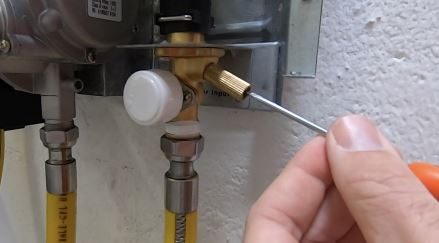
Screwdriver turning the OPV grub screw back so the valve starts to drip

To stop other pipes, indoors or outdoors, from being damaged by freezing water, open a tap to a slight drip and leave it dripping overnight, or for as long as temperatures stay below freezing. This keeps the ground water, which is generally warmer, flowing through the pipes. Remember to recycle your water.
Safety Tip

Fire Blanket

Always keep an easy-to-use fire blanket in your kitchen, especially when cooking with oil, which is highly flammable when boiling hot.

LPG Cylinder Safety Checks

Make sure your gas cylinder is filled in good time, so you are not caught without one.

  • When you receive a filled cylinder, make sure it has been legally and safely filled.
  • Check that a shrink-wrap seal covers the cylinder valve.
  • If there is no seal, or the seal is clear with no writing or branding, do not accept the cylinder.
  • If the seal only says "LPG" or "LPGas", do not accept the cylinder, even if the seal is coloured.
  • The only acceptable seal carries the same branding, logo or name, as the body of the cylinder itself.

  • Important: always work in a well-ventilated area.
  • Roll-about heaters connect to the LPG cylinder with an orange hose and a regulator. The regulator screws into the cylinder valve.
  • Always make sure the cylinder valve is closed before loosening or removing the regulator.
  • Check that there is a rubber seal on the end of the regulator. This seal, also called a bullnose, O-ring or washer, sits between the regulator and the cylinder valve.
  • Make sure the seal is in place and in good condition, not perished, cracked or damaged. Seals can become brittle over time, may split, or can even become lodged inside the cylinder valve.
  • A damaged seal is a prime cause of gas leaks. Check seals regularly.
  • The regulator has a left-hand thread: turn it anti-clockwise to connect it and clockwise to remove it.

  • Once the regulator is connected, open the cylinder valve one and a half turns only. There is no need to open it further.
  • Before lighting the heater, wait about half a minute and check for any smell of gas.
  • If you smell gas, close the valve immediately and take the cylinder and heater to an LPG dealer to be checked and, if necessary, serviced.
  • You can also check for leaks by applying soapy water to all joints. Bubbles mean gas is leaking.
  • Once you have checked for leaks, lift the cylinder into the housing behind the heater and close the housing panel or backing plate.
  • The cylinder must sit in the space at the back of the heater, so it cannot be knocked over.
  • Use the correct cylinder size for your heater.
  • Once the cylinder is safely in place, light the heater.
Get a Certified Gas Installation

Safety Tip

Minimum LPG cylinder clearances

Keep an LPG cylinder at least this far from each of these.
Keep the cylinder at leastFrom
1 mDoors
1 mWindows
2 mOpen drains
5 mElectrical switches or motors

Safety Tip

Choosing the right fire extinguisher

Newer, more efficient cooking appliances and the use of unsaturated cooking oils call for an extinguishing agent that does more than smother a fire: it also needs to cool it.

F-Class fire extinguishers meet the requirements of EN3 and PED for fires involving combustible vegetable or animal fats in commercial cooking equipment.

Get Gas Done Right the First Time

Registered installers, one team, quote through to signed-off certificate. Tell us what you need and we will take care of it.